Shipping Guide
Introduction
If you've ever requested a freight quotation, booked cargo, or spoken with a freight forwarder, you've probably been asked for the dimensions of your shipment.
The reason is simple: shipping companies need to know how much space your cargo occupies. This is where CBM comes in.
CBM, short for Cubic Meter, is one of the most important measurements used in international shipping. It helps freight forwarders, shipping lines, airlines, and logistics professionals calculate cargo volume, plan container space, and determine shipping costs.
From my logistics experience, CBM is one of the first calculations every importer and exporter should understand before requesting a freight quote. Over the years, I have seen shipments quoted incorrectly simply because cargo dimensions were missing or calculated incorrectly.
The good news is that CBM is easy to understand once you learn the basic formula.
In this guide, you'll learn what CBM means, how to calculate it, why it matters, and how it can affect your freight costs.
What Does CBM Mean in Shipping?
CBM stands for Cubic Meter.
A cubic meter is a unit used to measure cargo volume. In shipping, it tells us how much physical space a shipment occupies.
Think of it this way:
- Weight tells us how heavy the cargo is.
- CBM tells us how much space the cargo takes.
Both measurements are important because shipping companies consider weight and volume when calculating freight charges.
Why Is CBM Important?
Freight Cost Calculations
Many freight charges are based on the volume occupied by cargo rather than just the actual weight. The more space your shipment uses, the more it may cost to transport.
Container Planning
Freight forwarders use CBM to determine:
- How much cargo can fit into a container
- Available container capacity
- Whether the shipment should move as LCL or FCL
- Loading and stacking possibilities
LCL Shipments
For Less than Container Load (LCL) shipments, freight is commonly charged based on CBM. Since multiple customers share the same container, each customer pays according to the space occupied by their cargo.
Air Freight
In air freight, CBM is used to calculate volumetric weight, which helps airlines charge fairly for lightweight but bulky cargo.
How to Calculate CBM
The formula is straightforward:
CBM = Length × Width × Height
All measurements should be converted into meters before calculating.
Example
- Length = 120 cm
- Width = 80 cm
- Height = 60 cm
Convert to meters: 1.2 m × 0.8 m × 0.6 m = 0.576 m³. The shipment volume is 0.576 CBM.
How to Calculate CBM for Multiple Cartons
If all cartons are identical:
Total CBM = Single Carton CBM × Quantity
Example
Single carton: 0.5 × 0.4 × 0.3 = 0.06 CBM. Quantity: 20 cartons. Total volume: 0.06 × 20 = 1.2 CBM.
Real-World Example: Mango Export Shipment
Let's look at a practical example similar to export shipments commonly handled during mango season.
Shipment Details
- Commodity: Mangoes
- Carton Size: 16 × 12 × 4 inches
- Gross Weight: 6 KG per carton
- Quantity: 3,500 cartons
Step 1: Convert Dimensions to Meters
- Length: 16 inches = 0.4064 meters
- Width: 12 inches = 0.3048 meters
- Height: 4 inches = 0.1016 meters
Step 2: Calculate CBM Per Carton
CBM = 0.4064 × 0.3048 × 0.1016 = 0.01258 m³. Each carton occupies approximately 0.01258 CBM.
Step 3: Calculate Total Shipment CBM
Total CBM = 0.01258 × 3,500 = 44.03 CBM. The complete shipment occupies approximately 44.03 cubic meters.
Step 4: Calculate Total Gross Weight
6 KG × 3,500 cartons = 21,000 KG, or approximately 21 metric tons.
What Does This Mean?
A shipment with 44.03 CBM would typically require significant container space. The freight forwarder would use both the CBM and gross weight to request shipping rates, plan loading, check weight restrictions, and determine the best shipping method.
Use the Freight Learner CBM Calculator
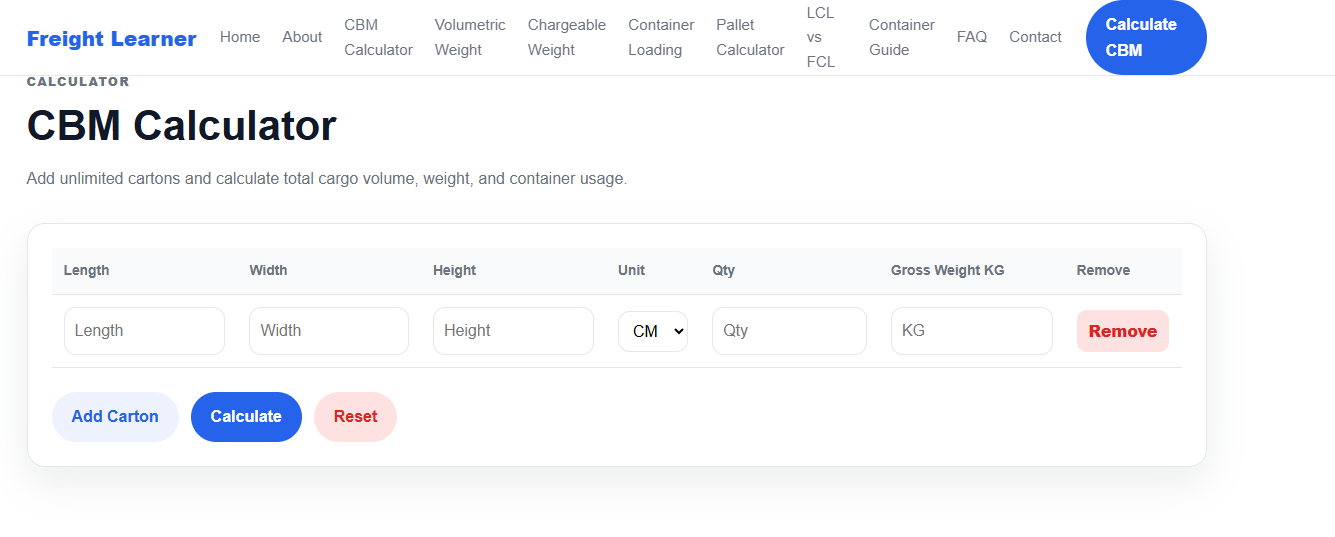
Instead of calculating manually every time, you can use the Freight Learner CBM Calculator.
Simply enter length, width, height, unit, quantity, and gross weight. The calculator automatically determines total CBM and shipment weight.
You can also add multiple cartons with different dimensions in a single calculation, making it useful for LCL shipments, export cargo, and mixed freight loads.
Approximate Container Capacity
20-Foot Container
Approximate Capacity: 28–33 CBM
40-Foot Container
Approximate Capacity: 58–67 CBM
40-Foot High Cube Container
Approximate Capacity: 68–76 CBM
Actual usable capacity depends on cargo dimensions, packaging, palletization, and stacking limitations. You can also use the Container Loading Calculator and Pallet Calculator for planning.
CBM vs Weight
| Measurement | Purpose |
|---|---|
| Weight | Measures how heavy cargo is |
| CBM | Measures cargo volume |
| Volumetric Weight | Converts volume into billable weight |
| Chargeable Weight | Used for freight pricing |
A shipment can be heavy but compact, or lightweight but bulky. Both factors influence shipping costs. To compare billable weight, use the Chargeable Weight Calculator.
Common CBM Calculation Mistakes
Not Converting Units Properly
Always convert dimensions correctly before calculating CBM.
Ignoring Packaging
Measure the complete packed carton, not only the product itself.
Forgetting Quantity
Many people calculate one carton but forget to multiply by total quantity.
Using Incorrect Dimensions
Always measure the longest length, widest width, and highest point.
Frequently Asked Questions
What is CBM in shipping?
CBM stands for Cubic Meter and measures the amount of space cargo occupies.
Why is CBM important?
CBM helps calculate shipping costs, container space requirements, and cargo planning.
Is CBM used in air freight?
Yes. CBM is used to calculate volumetric weight for air shipments.
Can two shipments have the same weight but different CBM?
Yes. A bulky shipment can have a much higher CBM even if the weight is identical.
How do I calculate CBM quickly?
Use the Freight Learner CBM Calculator by entering dimensions and quantity. The tool automatically calculates total cargo volume.
Conclusion
CBM is one of the most important measurements in shipping and logistics. Whether you're moving cargo by sea, air, or road, understanding CBM helps you obtain accurate freight quotations, plan shipments effectively, and avoid costly mistakes.
For importers, exporters, students, and logistics professionals, learning how to calculate CBM is a valuable skill that can save both time and money.
Before requesting your next freight quote, make sure you know your cargo dimensions, weight, and CBM. A few minutes spent calculating volume can help prevent unexpected costs later.