CBM Calculator Guide
Quick Summary
Before diving into the details, here are the key points:
- CBM stands for Cubic Meter.
- CBM measures cargo volume, not weight.
- Freight forwarders use CBM to calculate shipping costs and container space requirements.
- Accurate CBM calculations help avoid incorrect freight quotations.
- Both cargo dimensions and weight are required for proper shipment planning.
- A CBM calculator helps save time and reduce calculation errors.
What Is a CBM Calculator?
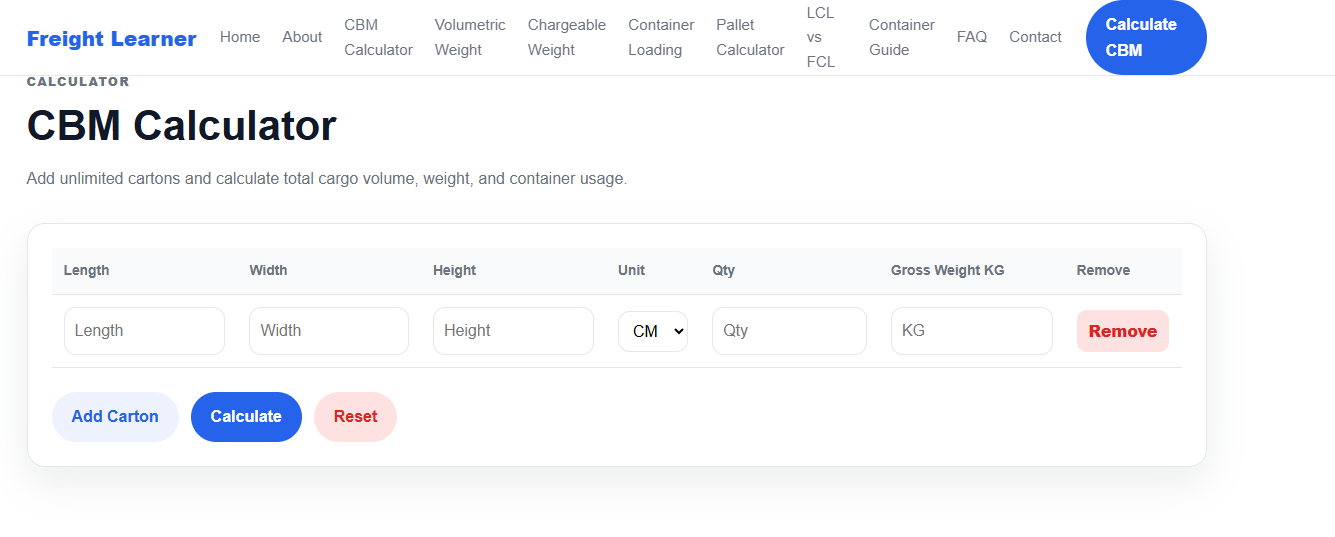
A CBM calculator is a simple freight tool that calculates how much space your cargo occupies. It uses shipment length, width, height, measurement unit, and quantity to calculate total cargo volume in cubic meters.
For a complete beginner explanation of CBM, you can also read our guide on what CBM means in shipping.
The basic formula is:
CBM = Length × Width × Height × Quantity
When using the Freight Learner CBM Calculator, you do not need to manually convert inches, centimeters, millimeters, feet, or meters every time. The calculator helps convert and calculate the final cargo volume quickly.
Who Should Use a CBM Calculator?
A CBM calculator is useful for anyone involved in shipping, logistics, or supply chain operations, including:
Importers
Importers can calculate cargo volume before requesting freight quotations and compare different shipping options more accurately.
Exporters
Exporters use CBM calculations to determine container requirements and estimate transportation costs before booking shipments.
Freight Forwarders
Freight forwarders rely on CBM calculations when preparing customer quotations, planning container utilization, and coordinating cargo movements.
Logistics Coordinators
Knowing shipment volume helps logistics teams optimize transportation planning and warehouse operations.
E-Commerce Sellers
Businesses shipping products internationally can use CBM calculations to estimate freight costs and improve inventory planning.
Students and Logistics Beginners
A CBM calculator is an excellent learning tool for understanding freight forwarding, shipping, and supply chain concepts.
Common CBM Mistakes We Have Seen in Real Shipments
One of the most expensive mistakes we encountered involved a textile export shipment packed in compressed bales.
The shipper had the total cargo weight available but did not have the cargo dimensions or total CBM. While it was clear that the shipment would require 40-foot High Cube containers, the exact number of containers could not be accurately determined without calculating the cargo volume.
To avoid delays, space was initially booked on eight 40-foot High Cube containers.
Once the cargo dimensions were measured and the CBM was calculated correctly, it became clear that only six containers were actually required.
As a result, two container bookings had to be cancelled, leading to avoidable cancellation charges and additional operational costs.
This situation highlights why weight alone is not enough when planning shipments. Accurate CBM calculations help determine container requirements, improve space utilization, reduce transportation costs, and prevent expensive booking mistakes.
Why Freight Forwarders Always Ask for Dimensions
Many first-time shippers are surprised when freight forwarders request carton dimensions in addition to cargo weight.
The reason is simple.
Two shipments may weigh exactly the same but occupy completely different amounts of space.
For example:
- Shipment A: 1,000 KG packed compactly on a few pallets.
- Shipment B: 1,000 KG packed in large lightweight cartons.
Although both shipments weigh the same, Shipment B occupies significantly more space and may cost more to transport.
This is why freight forwarders require both dimensions and weight before providing a freight quotation. For air freight and courier shipments, this also connects with volumetric weight and chargeable weight.
Before Requesting a Freight Quote
To receive an accurate shipping quotation, try to have the following information available:
- Cargo dimensions
- Number of cartons or pallets
- Gross weight
- Total CBM
- Origin country
- Destination country
- Preferred shipping method, such as Air, LCL, FCL, or Courier
Providing complete shipment information helps freight forwarders provide more accurate rates and reduces the risk of unexpected charges later.
Use Related Freight Learner Calculators
Depending on your shipment type, these tools can also help with planning:
- CBM Calculator for cargo volume.
- Chargeable Weight Calculator for billable freight weight.
- Volumetric Weight Calculator for air freight and courier calculations.
- Pallet Calculator for palletized cargo planning.
- LCL vs FCL Calculator for shipment mode comparison.
- Container Loading Calculator for container space planning.
Frequently Asked Questions
What does a CBM calculator do?
A CBM calculator calculates cargo volume by using the length, width, height, unit, and quantity of the shipment.
Who should use a CBM calculator?
Importers, exporters, freight forwarders, logistics coordinators, e-commerce sellers, students, and logistics beginners can use a CBM calculator.
Why do freight forwarders ask for dimensions?
Freight forwarders ask for dimensions because weight alone does not show how much container or cargo space a shipment will occupy.
Can wrong CBM cause extra shipping costs?
Yes. Incorrect or missing CBM can lead to wrong freight quotations, poor container planning, booking changes, and avoidable charges.
What information is needed before requesting a freight quote?
Cargo dimensions, number of cartons or pallets, gross weight, total CBM, origin, destination, and preferred shipping method help freight forwarders quote accurately.
Editorial Note
This article is reviewed periodically to ensure accuracy and relevance. Freight Learner aims to provide practical, beginner-friendly logistics education based on real-world freight forwarding and supply chain experience.
About Freight Learner
Freight Learner is an educational platform dedicated to simplifying freight forwarding, shipping calculations, logistics operations, and supply chain concepts through practical guides, calculators, and industry resources.