Sea Freight
Sea Freight
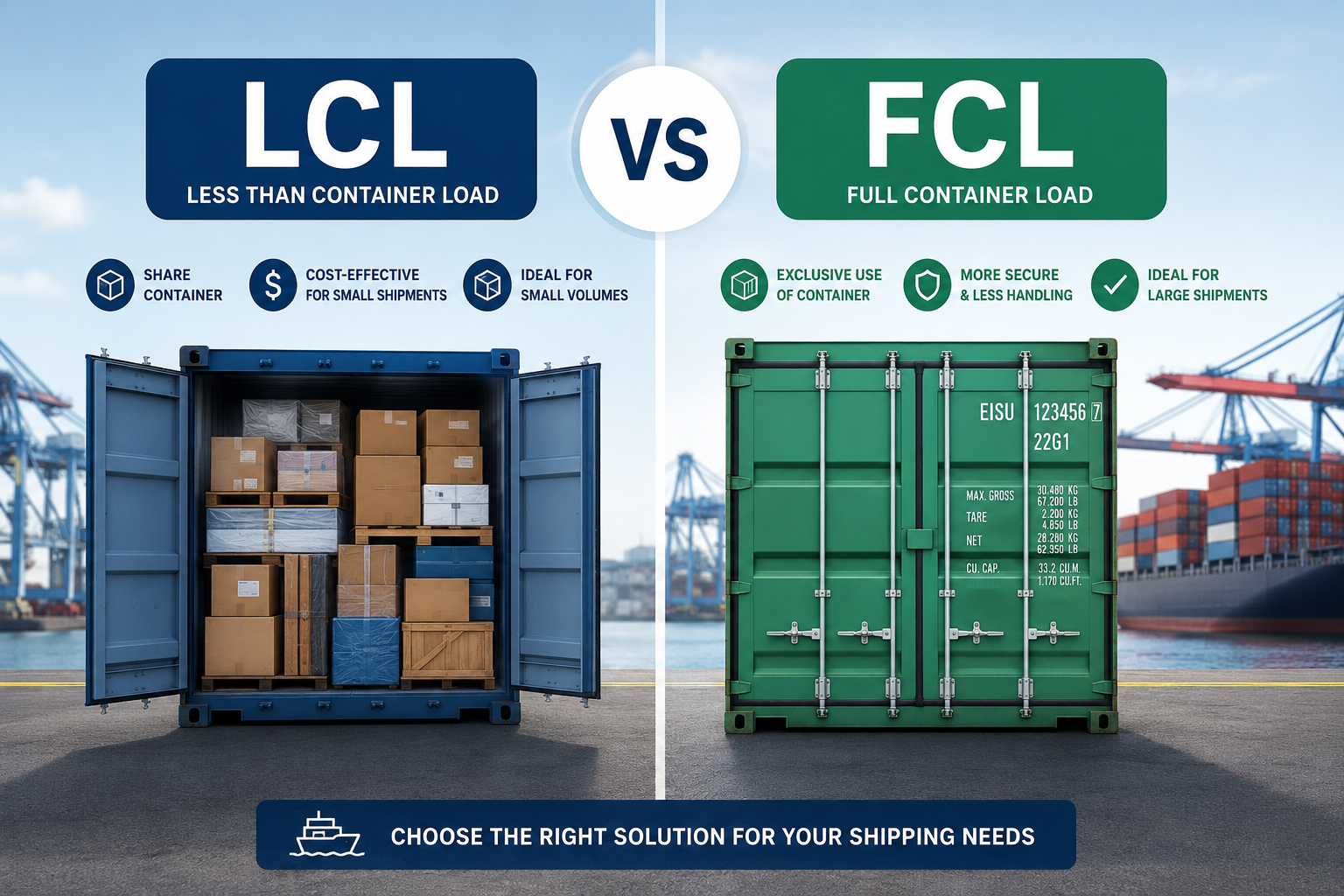
If you're importing or exporting goods by sea, one of the first decisions you'll need to make is whether to ship using LCL (Less than Container Load) or FCL (Full Container Load).
Many first-time importers assume they need to book an entire container for every shipment. In reality, that's not always necessary.
The right choice depends on several factors, including cargo volume, shipping costs, transit time, cargo value, and delivery urgency.
Understanding the difference between LCL and FCL can help you reduce freight costs, avoid delays, and choose the most efficient shipping method for your business.
In this guide, we'll explain how both options work and when each one makes the most sense.
LCL stands for Less than Container Load.
In LCL shipping, your cargo shares container space with shipments belonging to other importers or exporters.
Instead of paying for an entire container, you pay only for the space your cargo occupies.
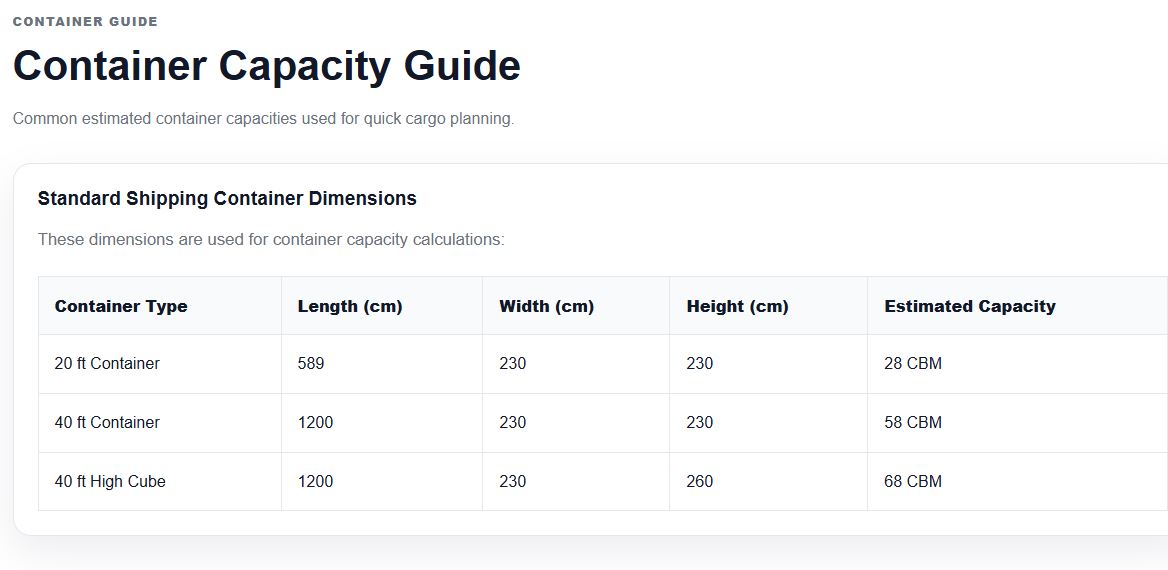
Imagine your shipment volume is 5 CBM. A standard container can hold much more cargo than that.
Rather than booking an entire container, your freight forwarder consolidates your shipment with cargo from other customers. You pay only for your 5 CBM.
FCL stands for Full Container Load.
With FCL, you book the entire container exclusively for your shipment.
The container is loaded with your cargo and remains sealed until it reaches its destination.
Even if you don't fully utilize the available space, the container is reserved exclusively for your goods.
Your shipment volume is 28 CBM. At this point, booking an entire container may be more economical than paying LCL charges.
| Factor | LCL | FCL |
|---|---|---|
| Container Usage | Shared with others | Exclusive container |
| Cost for Small Shipments | Usually cheaper | Usually more expensive |
| Cost for Large Shipments | Can become expensive | Often more economical |
| Transit Time | Slightly longer | Usually faster |
| Cargo Handling | More handling | Less handling |
| Risk of Damage | Slightly higher | Lower |
| Customs Delays | Possible due to shared cargo | Less common |
| Best For | Small shipments | Medium to large shipments |
The process typically follows these steps:
Because multiple shipments are involved, additional handling is required.
The process is generally simpler:
This reduces cargo handling and often speeds up the process.
LCL is usually a good option when:
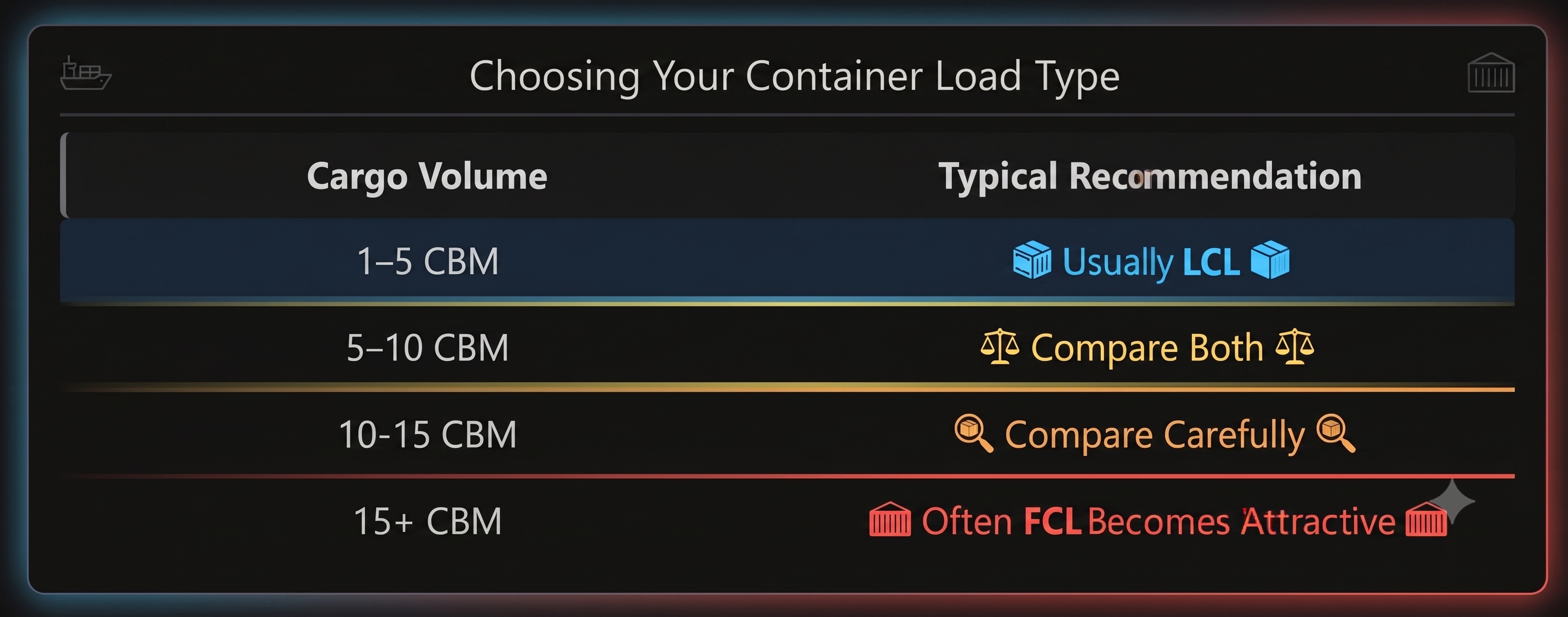
Many freight forwarders recommend LCL for shipments below approximately 12–15 CBM.
Paying only for the space used can reduce transportation costs for smaller shipments.
Businesses importing occasionally often find LCL more practical than booking full containers.
FCL may be the better choice when:
Once shipment volume increases, container rates often become more economical than paying per CBM.
FCL cargo typically experiences fewer consolidation and deconsolidation delays.
Less handling means a lower risk of damage.
The container remains dedicated to your cargo throughout the journey.
During my time working in import operations, we regularly sourced products from multiple suppliers in Vietnam for a vendor based in Uzbekistan.
Although the suppliers were located close to each other, each supplier produced different quantities for the same shipment cycle. Before planning transportation, we would collect the cargo dimensions from each supplier and calculate the total CBM of the shipment.
The combined cargo volume played a major role in determining whether we should book Full Container Load (FCL) containers or move part of the shipment via Less than Container Load (LCL).
For example, on one shipment:
After calculating the total shipment volume, we planned container bookings accordingly to maximize container utilization and reduce transportation costs.
Any remaining cargo that could not efficiently fill another container was often shipped using LCL instead of booking an additional underutilized container.
This approach helped optimize freight costs, improve container utilization, and reduce unnecessary shipping expenses. It also demonstrated why accurate CBM calculations are essential when planning international shipments involving multiple suppliers.
Choosing the wrong shipping method can lead to:
Understanding both options allows businesses to plan shipments more effectively, compare freight quotations accurately, improve logistics budgeting, and optimize transportation costs.
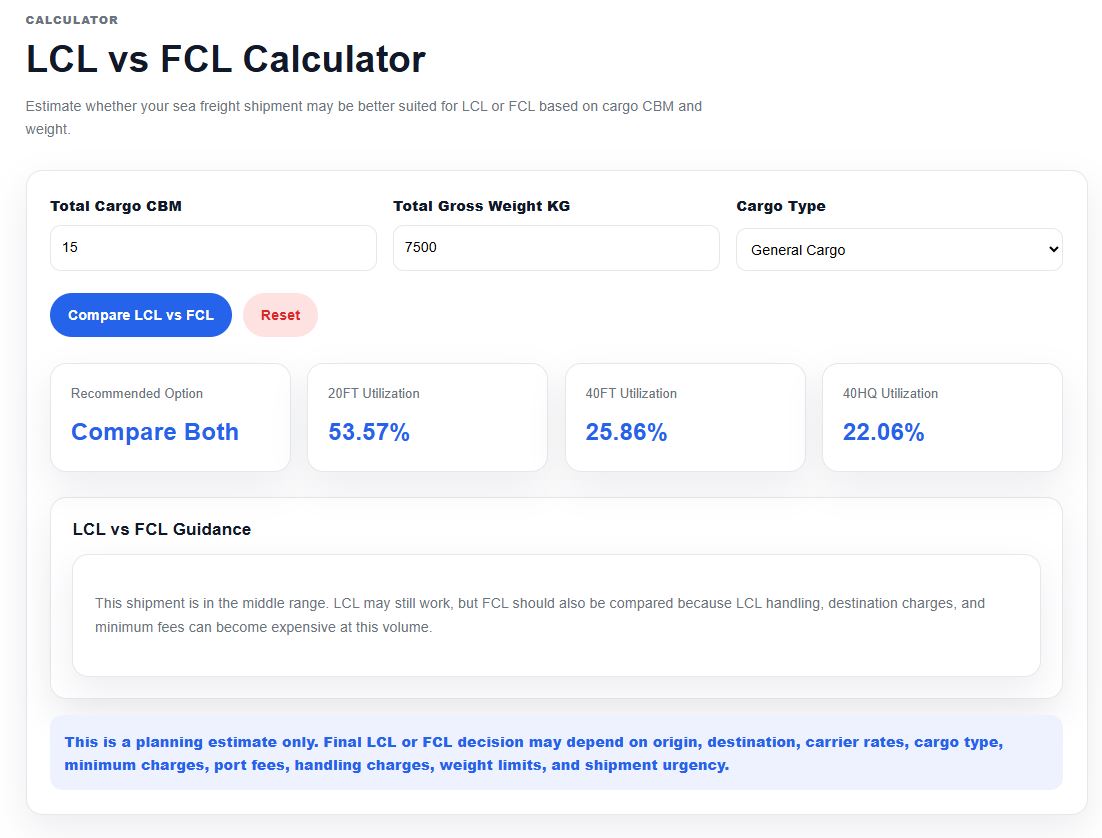
CBM (Cubic Meter) is one of the most important factors when deciding between LCL and FCL.
A shipment with 2 CBM, 5 CBM, or 8 CBM is often suitable for LCL.
However, as cargo volume increases, FCL frequently becomes more economical.
Before choosing a shipping method, use Freight Learner's CBM Calculator to calculate shipment volume accurately.
You may also find our guide on What Is CBM in Shipping? helpful if you're unfamiliar with volume calculations.
Many businesses assume LCL is always cheaper. This is not always true.
Incorrect cargo measurements can result in selecting the wrong shipping method.
LCL shipments often include consolidation fees, deconsolidation fees, and handling charges.
Transit time, cargo safety, and handling requirements should also be considered.
One lesson I learned while working in freight forwarding is that many businesses focus only on the quoted freight rate.
However, the lowest rate is not always the most cost-effective option.
In several cases, customers selected LCL because the initial quotation appeared cheaper. After accounting for handling fees, destination charges, and additional transit time, FCL would have provided better value.
Always compare the total logistics cost rather than focusing only on the freight charge.
When evaluating LCL and FCL quotations, consider:
Sometimes an LCL shipment appears cheaper initially but becomes more expensive after destination charges are included.
If your shipment volume is approaching 15 CBM, always request both LCL and FCL quotations. Market conditions can change frequently, and the cost difference between the two options may be smaller than expected.
LCL stands for Less than Container Load. Your cargo shares container space with shipments from other customers.
FCL stands for Full Container Load. You reserve an entire container exclusively for your cargo.
For small shipments, LCL is often cheaper. For larger shipments, FCL can become more economical.
In many cases, yes. FCL usually requires less cargo handling and fewer consolidation procedures.
There is no fixed rule because freight rates change frequently. However, many shipments between 12 and 18 CBM are worth comparing against FCL rates.
Calculate your cargo volume first and compare freight quotations for both options. Freight Learner's LCL vs FCL Calculator can help determine which option may be more cost-effective.
Yes. Because LCL cargo must be consolidated and deconsolidated with other shipments, delays can occasionally occur if documentation or customs issues affect another shipment within the same container.
LCL and FCL are both valuable shipping options, but each serves a different purpose.
LCL is generally suitable for smaller shipments where paying only for occupied space makes sense.
FCL becomes attractive when cargo volume increases, shipment control is important, or minimizing handling is a priority.
Before booking freight, always calculate your shipment volume, compare quotations, and evaluate the total logistics cost rather than focusing only on freight rates.
The right choice can save money, reduce delays, and improve the overall shipping experience.