Air Freight Guide
Air Freight Guide
If you've ever requested an air freight quotation, you may have noticed something confusing.
Your shipment might physically weigh 300 kg, but the airline charges you as if it weighs 500 kg.
Why does this happen?
The answer is chargeable weight.
Chargeable weight is one of the most important concepts in air freight pricing. Airlines do not simply charge based on how heavy a shipment is. They also consider how much space it occupies inside the aircraft.
Understanding this concept can help importers, exporters, freight forwarders, and e-commerce sellers estimate shipping costs more accurately and avoid surprises when receiving freight quotations.
Chargeable weight is the figure airlines use to calculate air freight charges.
To determine it, airlines compare:
Whichever value is higher becomes the chargeable weight used for billing.
If the cargo is heavy and compact, freight charges are usually based on its physical weight.
If the cargo is lightweight but occupies a large amount of space, freight charges are usually based on its volumetric weight.
The higher value becomes the billable weight.
Aircraft have two main limitations:
Some shipments are dense and heavy, while others are lightweight but bulky.
If airlines charged only by physical weight, large lightweight shipments would consume valuable cargo space while generating very little revenue.
Chargeable weight helps airlines balance both weight and space fairly.
Physical weight refers to the actual weight measured on a scale.
If a shipment contains 10 cartons with a total weight of 300 kg, then the physical weight is 300 kg.
This measurement only considers how heavy the shipment is. It does not consider how much space the cargo occupies.
Volumetric weight converts cargo volume into a weight equivalent. It reflects the amount of space occupied inside the aircraft.
Large but lightweight shipments often have a higher volumetric weight than their physical weight.
Before calculating volumetric weight, it is useful to calculate shipment volume. You can use Freight Learner's CBM Calculator for this.
If you are new to cargo volume calculations, read our guide on CBM Calculator what CBM means in shipping Volumetric Weight Calculator Chargeable Weight Calculator LCL vs FCL Calculatorwhat CBM means in shipping.
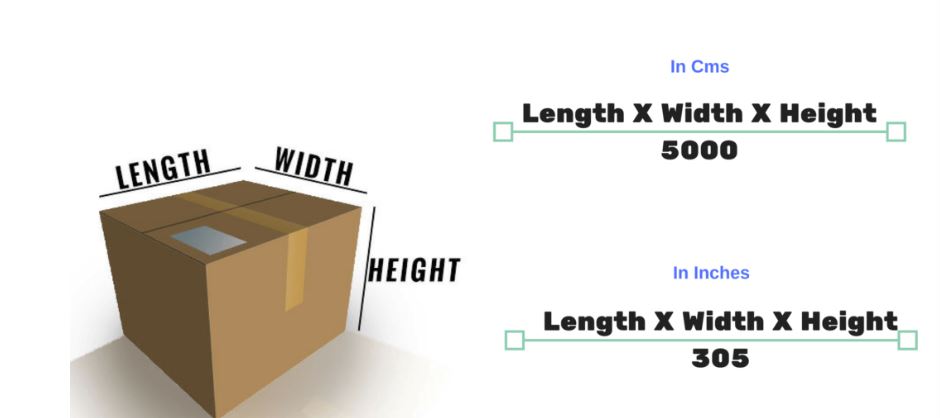
Most airlines commonly use the following formula:
Volumetric Weight (kg) = Length (cm) × Width (cm) × Height (cm) ÷ 6000
Dimensions are measured in centimeters, and the result is expressed in kilograms.
You can also use Freight Learner's Volumetric Weight Calculator to calculate dimensional weight instantly.
Suppose a shipment has the following details:
(100 × 80 × 60) ÷ 6000 = 80 kg
| Measurement | Result |
|---|---|
| Physical Weight | 50 kg |
| Volumetric Weight | 80 kg |
Since volumetric weight is higher, the chargeable weight becomes 80 kg.
The airline will calculate freight charges using 80 kg.
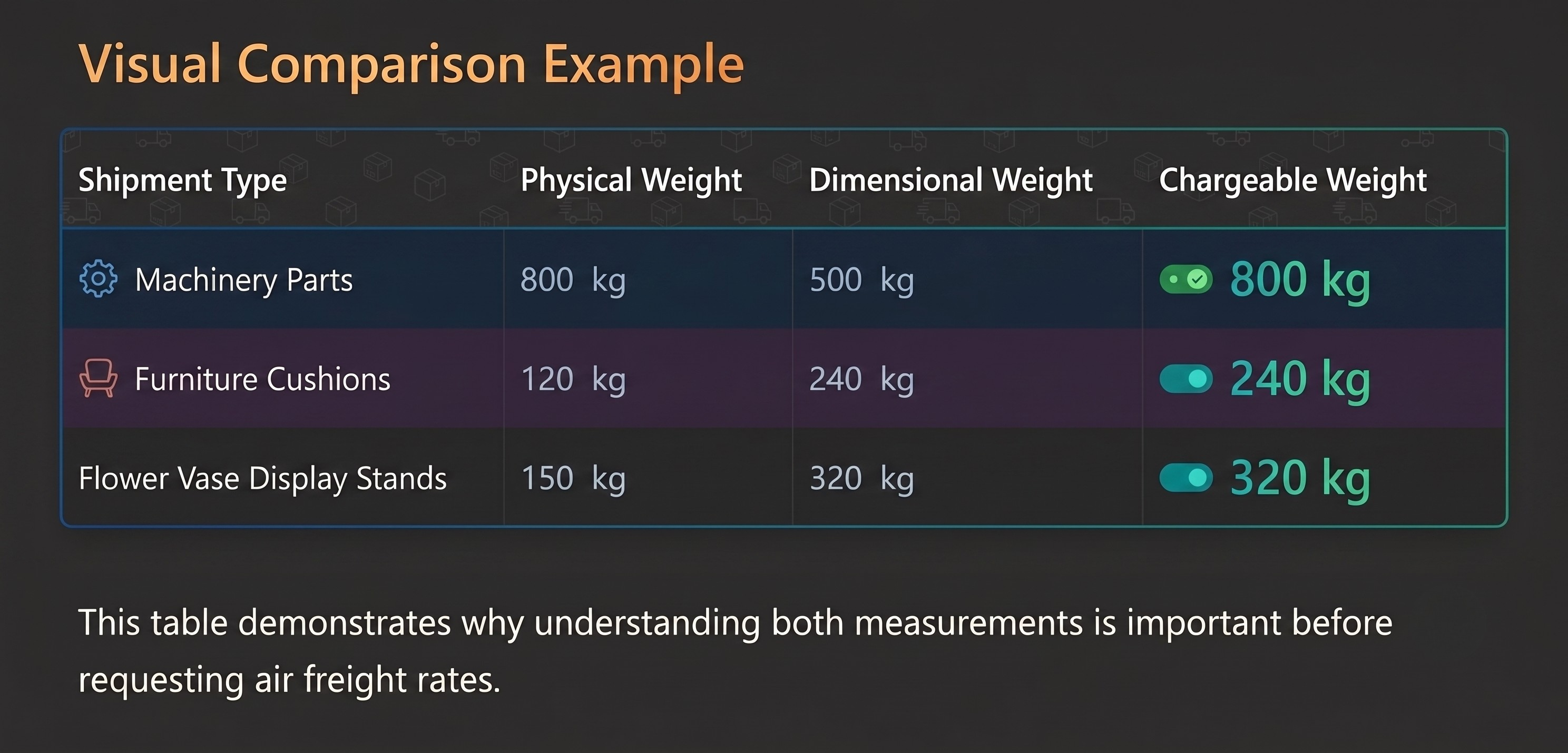
| Shipment Type | Physical Weight | Volumetric Weight | Chargeable Weight |
|---|---|---|---|
| Machinery Parts | 800 kg | 500 kg | 800 kg |
| Furniture Cushions | 120 kg | 240 kg | 240 kg |
| Flower Vase Display Stands | 150 kg | 320 kg | 320 kg |
Many businesses focus only on shipment weight when budgeting transportation costs. However, dimensions can significantly impact freight pricing.
Understanding chargeable weight helps businesses:
For bulky cargo, sea freight may be more cost-effective. You can use Freight Learner's LCL vs FCL Calculator to compare shipment options.
During my time working in freight forwarding, I received a quotation request for flower vase display stands being shipped by air.
The customer initially provided only the shipment weight, which was around 150 kg.
Once the cargo dimensions were measured, the volumetric weight exceeded 320 kg.
The final freight cost was significantly higher than expected because the shipment occupied much more aircraft space than its actual weight suggested.
This is one of the most common mistakes first-time exporters make when requesting air freight quotations.
One lesson I learned while working in logistics is that customers often focus only on how much their cargo weighs.
However, airlines care about both weight and space.
In several cases, shipments weighing less than 200 kg were billed at more than double that amount because of their large dimensions.
Measuring cargo accurately before requesting a quotation can prevent unexpected freight costs, delays, and last-minute budget issues.
Freight forwarders need dimensions to calculate volumetric weight. Providing only weight often results in inaccurate quotations.
Always measure the fully packed shipment, including cartons, pallets, protective materials, and packaging inserts.
Incorrect conversions between inches, centimeters, and meters can lead to major calculation errors.
Even small dimension differences can significantly affect air freight charges for larger shipments.
Remove unnecessary empty space inside cartons.
Oversized cartons increase dimensional weight unnecessarily.
Combining multiple shipments may improve packaging efficiency.
For bulky cargo, sea freight may be more cost-effective. You can use Freight Learner's LCL vs FCL Calculator to compare shipment options.
Use Freight Learner's Chargeable Weight Calculator by entering length, width, height, and shipment weight.
Chargeable weight is the weight airlines use to calculate air freight charges. It is the higher of physical weight and volumetric weight.
Because airlines consider both weight and cargo space. If the shipment occupies significant space, volumetric weight may exceed physical weight.
It is primarily used in air freight, but similar dimensional pricing methods are also common in courier and express shipping services.
The airline usually uses the volumetric weight as the chargeable weight.
Yes. Courier companies generally compare physical weight and volumetric weight. The higher value is usually used to calculate shipping charges.
Use Freight Learner's Chargeable Weight Calculator by entering length, width, height, and shipment weight.
If you have not yet calculated your shipment volume, use our CBM Calculator, Volumetric Weight Calculator, and Chargeable Weight Calculator before requesting freight quotations.
Chargeable weight is a fundamental concept in air freight and one that every importer, exporter, and logistics professional should understand.
Airlines compare the physical weight of cargo with its volumetric weight and use the higher value for billing.
Understanding this process allows businesses to estimate shipping costs more accurately, plan packaging efficiently, avoid unexpected freight charges, and make better transportation decisions.
Before requesting any air freight quotation, always provide both dimensions and shipment weight. Doing so helps freight forwarders provide accurate rates and prevents costly surprises later.
The volumetric conversion factor used in this article is a common industry standard. However, airlines, courier companies, and freight forwarders may apply different conversion factors depending on their policies and service type.
Always confirm the applicable calculation method with your carrier or freight forwarder before booking a shipment.