Incoterms & Trade Terms
Incoterms & Trade Terms
A few years ago, I received a shipment inquiry from a first-time importer who believed the supplier would handle everything until the cargo reached his warehouse.
The supplier's quotation mentioned FOB Shanghai.
The importer assumed that meant transportation, insurance, customs clearance, and final delivery were all included.
A few weeks later, he was surprised by freight charges, destination handling fees, customs clearance costs, and local transportation expenses that he never budgeted for.
The shipment itself was fine.
The misunderstanding came from not understanding the Incoterm.
Situations like this happen every day in international trade. In many cases, the cargo moves smoothly, but confusion over responsibilities creates delays, disputes, and unexpected costs.
Understanding Incoterms 2020 can help importers, exporters, freight forwarders, and logistics teams avoid these problems and make better shipping decisions.
Incoterms stands for International Commercial Terms.
They are a set of globally recognized trade rules published by the International Chamber of Commerce (ICC).
These rules define: Who arranges transportation Who pays transportation costs Who handles export clearance Who handles import clearance When risk transfers from seller to buyer
One common misunderstanding is that Incoterms determine ownership of goods or payment terms.
They do not.
Incoterms only clarify responsibilities, costs, and risk during transportation.
Think of Incoterms as a rulebook that helps buyers and sellers understand exactly who is responsible for each stage of the shipment journey.
In freight forwarding, many shipment problems begin before cargo even leaves the factory.
The issue is often not transportation.
The issue is unclear expectations.
Proper use of Incoterms helps:
Whenever I review a shipping request, one of the first questions I ask is:
"What Incoterm is being used?"
Without that information, it is impossible to provide an accurate freight solution.
One lesson many new importers learn the hard way is that risk and cost do not always transfer at the same point.
For example:
Under CIF, the seller pays for freight and insurance.
Many buyers assume this means the seller carries all risk.
That is incorrect.
Risk transfers much earlier when the cargo is loaded onto the vessel at the port of origin.
This distinction becomes important when cargo is damaged or lost during transit.
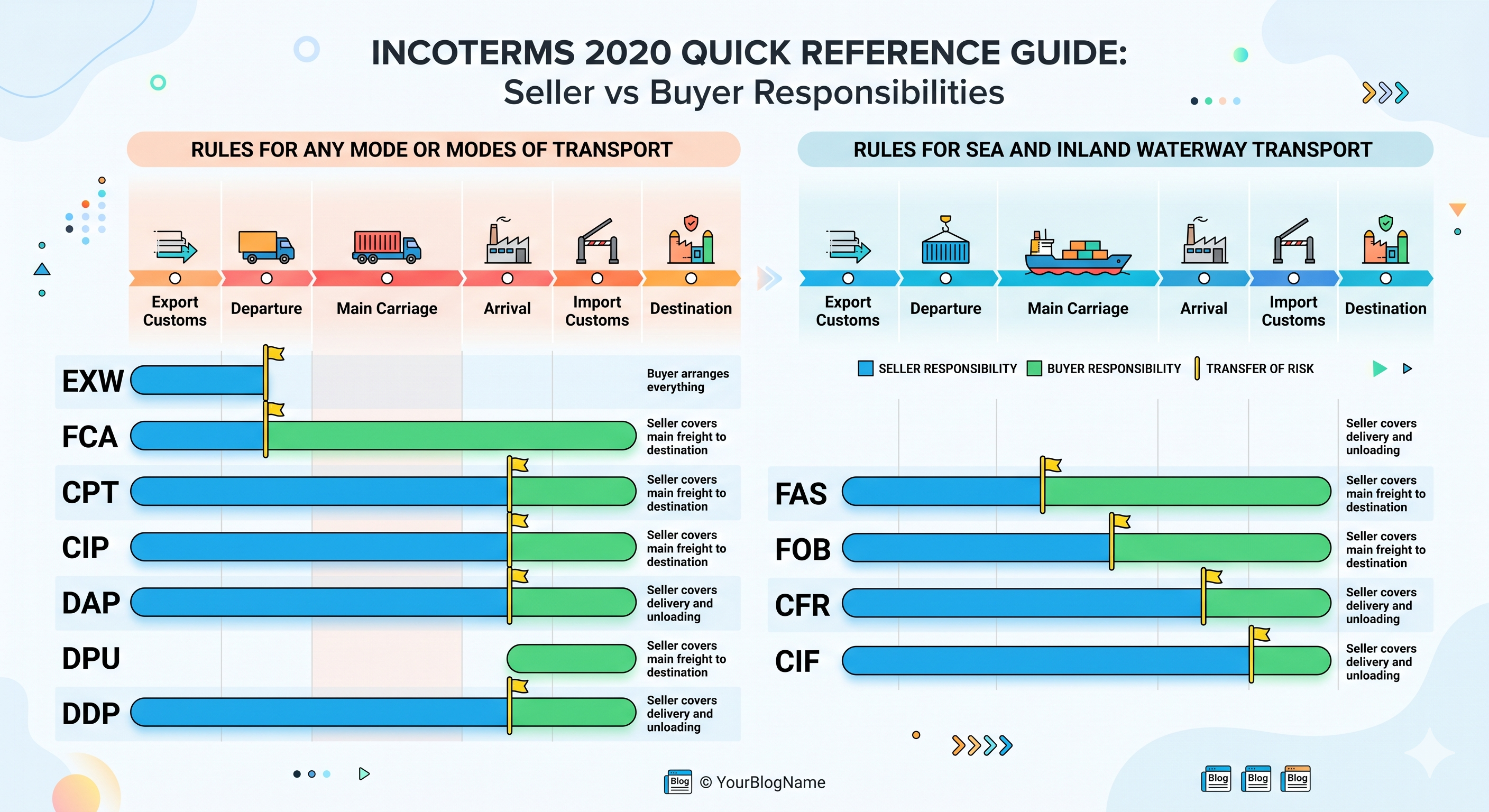
Incoterms can generally be divided into two groups.
This Incoterms 2020 comparison table shows who is responsible for export clearance, freight costs, insurance, and import clearance between buyer and seller.
| Incoterm | Export Clearance | Main Freight | Insurance | Import Clearance |
|---|---|---|---|---|
| EXW | Buyer | Buyer | Buyer | Buyer |
| FCA | Seller | Buyer | Buyer | Buyer |
| FOB | Seller | Buyer | Buyer | Buyer |
| CFR | Seller | Seller | Buyer | Buyer |
| CIF | Seller | Seller | Seller | Buyer |
| CPT | Seller | Seller | Buyer | Buyer |
| CIP | Seller | Seller | Seller | Buyer |
| DAP | Seller | Seller | Seller Optional | Buyer |
| DPU | Seller | Seller | Seller Optional | Buyer |
| DDP | Seller | Seller | Seller Optional | Seller |
The seller makes goods available at their premises.
The buyer handles nearly everything else.
In practice, EXW often creates operational challenges because foreign buyers may struggle to arrange export clearance in the seller's country.
Many freight forwarders prefer FCA instead.
FOB remains one of the most common sea freight terms.
The seller:
The buyer:
For many importers, FOB provides a good balance of control and responsibility.
Under CIF, the seller pays:
The buyer remains responsible for:
A common mistake is assuming CIF means "door delivery."
It does not.
The seller arranges transportation up to the agreed destination.
The buyer handles:
This is frequently used when sellers want to provide convenient delivery while avoiding foreign customs obligations.
DDP places maximum responsibility on the seller.
The seller handles:
Many new importers love DDP because it appears simple.
However, sellers may add significant margins to cover risk and administrative work.
A shipment of furniture is moving from Shenzhen, China, to Karachi, Pakistan.
Scenario 1: FOB Shenzhen
Seller pays:
Buyer pays:
Scenario 2: CIF Karachi
Seller pays:
Buyer still pays:
Scenario 3: DDP Karachi
Seller manages almost everything until delivery.
Buyer simply receives the cargo.
Each option changes pricing, control, and risk exposure.
Assuming CIF Includes Everything
This is one of the most frequent misunderstandings.
Destination charges and customs costs still apply.
Using FOB for Air Freight
FOB is designed for sea freight.
For air shipments, FCA is usually more appropriate.
Ignoring Insurance Coverage
Basic CIF insurance may not fully protect valuable cargo.
Always review insurance limits.
Not Defining the Exact Location
Incoterms should include a precise location.
For example:
Choosing DDP Without Understanding Local Regulations
Some countries restrict foreign entities from acting as importers of record.
DDP may not always be practical.
Get the Incoterm Before Requesting Quotes
Freight costs can vary significantly depending on responsibilities.
Confirm Destination Charges Early
Many importers focus only on freight rates and overlook destination costs.
Review Insurance Separately
Do not assume cargo is fully covered.
Use FCA Instead of EXW When Possible
Put Everything in Writing
Purchase orders, quotations, and shipping instructions should clearly state the agreed Incoterm.
A single missing detail can create expensive misunderstandings later.
Incoterms 2020 are internationally recognized trade rules that define transportation responsibilities, costs, and risk transfer between buyers and sellers.
The International Chamber of Commerce (ICC) publishes and updates Incoterms.
Many importers find FOB easier because responsibilities are clearly divided between seller and buyer.
No. Customs duties, taxes, and import clearance remain the buyer's responsibility.
Not necessarily. DDP offers convenience but may increase overall costs.
No. FCA is generally recommended for air shipments.
DAP requires the buyer to handle import clearance and duties, while DDP requires the seller to handle them.
No. Payment terms and ownership are separate from Incoterms.
Over the years, I have noticed that many shipping disputes are not caused by damaged cargo, delayed vessels, or customs inspections.
They start with a simple misunderstanding of responsibilities.
Incoterms 2020 provide a common language that helps buyers, sellers, freight forwarders, and logistics teams work together more effectively.
Before booking any international shipment, take a few minutes to verify the agreed Incoterm, understand where risk transfers, and confirm who is responsible for each stage of the journey.
That small step can prevent unexpected costs, delays, and difficult conversations later.
This article is provided for educational purposes only. Shipping costs, freight rates, container capacity, and operational requirements may vary by carrier, country, cargo type, and shipment conditions.